

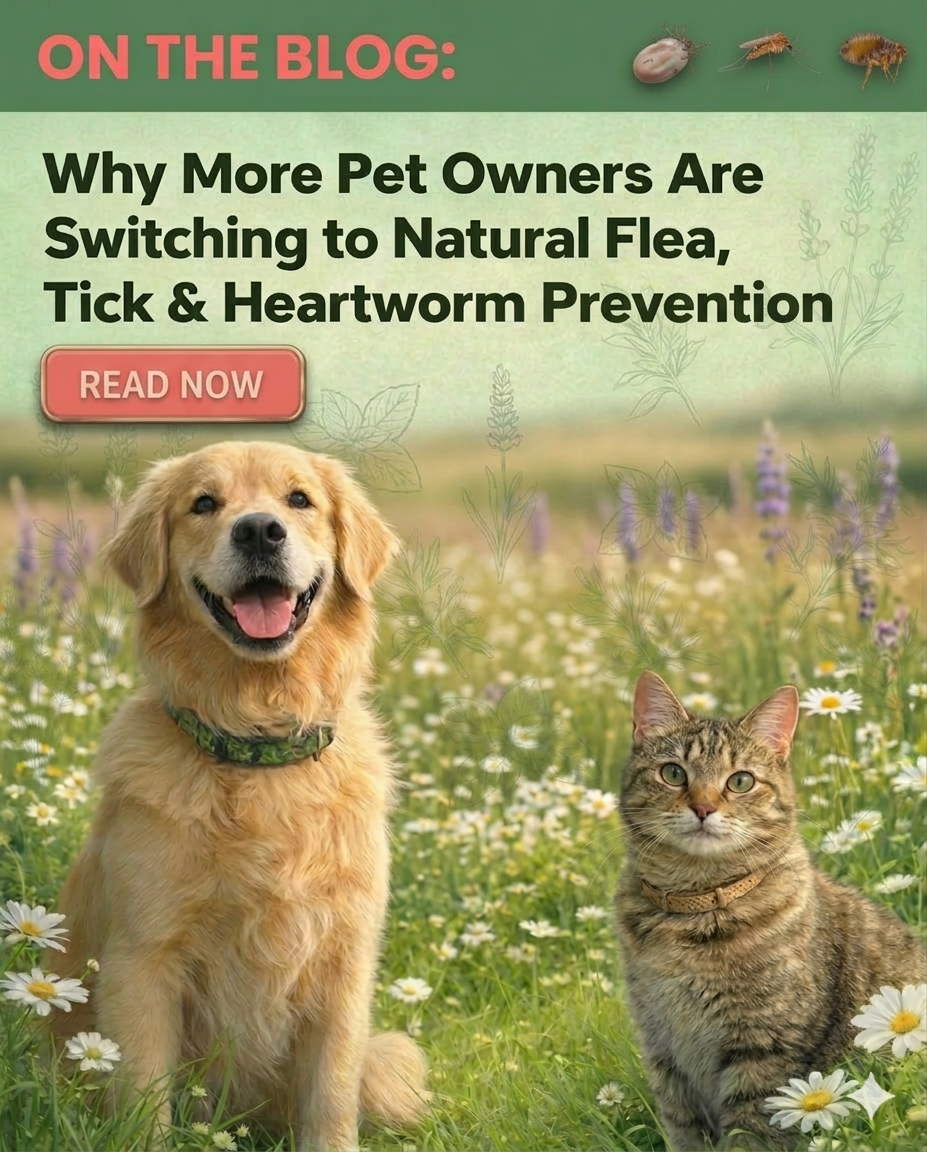
Natural Prevention for Ticks, Fleas and Mosquitos.
What we choose what to feed, how to vet and what we decide to put into our pets’ bodies is a very personal choice. This blog will look at the different options available to us to prevent the “bugs” from attaching and feeding while preventing the transmission of disease. What will follow contains my opinion as I always strive to deal with my pet’s health as naturally as possible.
A Special Note on Heartworm Prevalence in Ontario
The chances of your pet being infected with the heartworm microfilaria in our climate is rare. If you are being told by your neighbour, your vet or vet tech that heartworm in Ontario is considerable risk, then you need to ask them the following question. When was the last time you know a dog or cat was diagnosed with heartworm microfilaria that lives in Ontario and did not come from the deep south (or visited the southern states where transmission is likely)? Most pets showing a positive test for heartworm are rescues from southern states where the climate allows transmission to take place.
If you would like to learn more about heartworm and heartworm prevention, you can click HERE
FLEA AND TICK MEDICATIONS
I strongly believe that we can prevent ticks and fleas naturally while minimizing the risk of disease transmission. There are real risks of putting a parasiticide into my pet’s body. A natural prevention plan is enough to let me sleep at night versus always wondering what the short- and long-term consequences are of putting an insecticide in my pet’s system.
Let us have a closer look at the different options and the good, the bad and the ugly of each. We just want to help you make an informed decision as to how to keep your pet safe while allowing you to sleep at night.
These are the medications that are prescribed by veterinarians. They come in the form of a pill/chewy or a liquid to be applied onto the skin. Some of the top selling brands are Bravecto, Nexgard and Simparica.
The Good
The Not So Good
58% of the respondents gave the dog a flea treatment.
48% gave their dog a treatment containing a parasiticide.
66.6% of respondents who gave their dog a flea treatment said their dog experienced a reaction.
36.1% of respondents who have their dog a flea treatment said their dog DID NOT experience a reaction.
8.2% said they were unsure.
If you would like to read Project Jake’s peer-reviewed and open-access paper, you can check it out here: Project Jake
These chemicals are now seeping into the environment.
In a large UK study, 20 English Rivers were found to have elevated levels of fipronil and imidacloprid (Advantix). These chemicals can kill tiny aquatic insects, a crucial food source for fish and birds.
Additional studies of San Francisco Bay water treatment plants show that levels of both fipronil and imidacloprid routinely exceed toxicity values for aquatic invertebrates.
KEY FACT – Flea and Tick medications do not prevent the critters from getting on your pet’s body and attach and feed. These medications work by killing the critter once they stop feeding because the blood contains a parasiticide that your pet ingested.
INDOOR HOUSE CATS – If your cat spends most of the time indoors, then the risk of a critter getting on you cat is incredibly low. Again, this is a personal choice but please consider the risk of disease transmission versus the risks of giving you feline friend and parasiticide.
Flea, tick, and heartworm chemicals are causing horrendous side effects to dogs and cats. These chemicals are neurotoxins, and they attack the nervous system. Pet owners and veterinarians have reported seizures, tremors and paralysis, liver, and kidney failure.
If I had a choice of using a natural products(s) both topically and internally that are not dangerous, why wouldn’t I use that versus a dangerous chemical that can paralyze or kill my pet or have my pet on anti-seizure meds for the rest of it’s life?
NATURAL SOLUTIONS
There are some very effective solutions available to pet owners that can help create a natural defense to fleas and ticks attaching to your pet.
Earth M.D. Outdoor Shield is a mixture of garlic powder, spirulina, neem leaf and quassia bark. It is in powder form and is mixed into your pet’s food daily for 7 days. This creates a change in the smell of your pet’s skin and the taste of your pet’s blood that repels the critters. Repeat every 4 weeks starting in very early spring (March) through to the end of November or when the freezing weather begins. We have been using this powder for close to 15 years and is a great natural solution to deter the pests
Essential oil-based, non-chemical sprays can be effective repellents to fleas and ticks. Lavender, geranium and neem are some examples. However, some essential oils can be dangerous to cats, so you need to ensure that a spray you purchase or put together is cat safe. Natural spray repellents should be applied often during your walks and hikes. These sprays are effective in repelling the bugs for about 45 minutes.
The Tickless Ultrasonic device transmits a signal that disorients fleas and ticks and eventually deter the critters from attaching and feeding. Just attach it to a collar or harness.
Have a look HERE to see the prevention solutions that are available to you.
What about treating a dog or cat that gets fleas?
The best first line of finding and getting rid of fleas is a good flea comb. Make sure to really check around ears, the bum and other moist dark areas of you pet’s body.
There are excellent all-natural flea shampoos that can help rid your pet of fleas.
Finally, an all-natural powder called Diatomaceous Earth or DE, can be used. The DE we are referring to is a food-grade DE, not the DE that is used in some filtration units. It is a fine powder that is applied in your pet’s coat and should be combed through. DE powder is like tiny little swords that will cut through the eco-skeletal structure of a flea and will kill it. It can also be used to kill fleas if they get into your house. The one downside of DE is that it can easily get air-born and when inhaled it can cause irritation in the airways and lungs. Best not to use DE around individuals who are prone to breathing issues.
What about ticks? What do I do if I find a tick on my dog?
Ticks freak us out the most. They are nasty little critters that can attach onto our pets (and humans) and feed away on blood until they are engorged. The nasty side of this is that ticks can transmit some serious illnesses into our pets and us humans. The tick most of us are aware of is Lyme disease, primarily transmitted by the Deer Tick or black-legged tick. So here are a few things to consider:
Knowing your pet inside and out is best way to stay on top of ticks. Try your best to look and feel around your pet, especially the head area. Many ticks will get onto your pet from grasses and bushes/tree branches low to the ground and with most dogs, it is usually head-first. Right? Do not ignore the paws and legs as well. A good once-over after a hike or play in grassy and wooded areas is always a good idea.
Let us Summarize!
Flea and tick medications are effective but can create serious potential health consequences.
The Snap 4DX blood test is an effective way of screening for early heartworm detection. This same test can be used to identify Lyme disease if you find a deer tick on your pet. Again, early detection is important to properly treat and prevent long-term health consequences.
Natural approaches in conjunction with effective screening tools can be a solid plan when choosing not to put pesticides into your pet’s system.
How one chooses to protect their pet from insect-borne illnesses is a personal one. Your pet lifestyle and where you live and what it takes for you to sleep at night all play a role in what you decide to do. We just want to make sure that all pet parents make good, informed decisions about your overall pet’s health.
A blog from 2022 that is still relevant today: Ticks, Fleas and Heartworm 2022 Blog
THE PROOF IS IN THE POOP!